


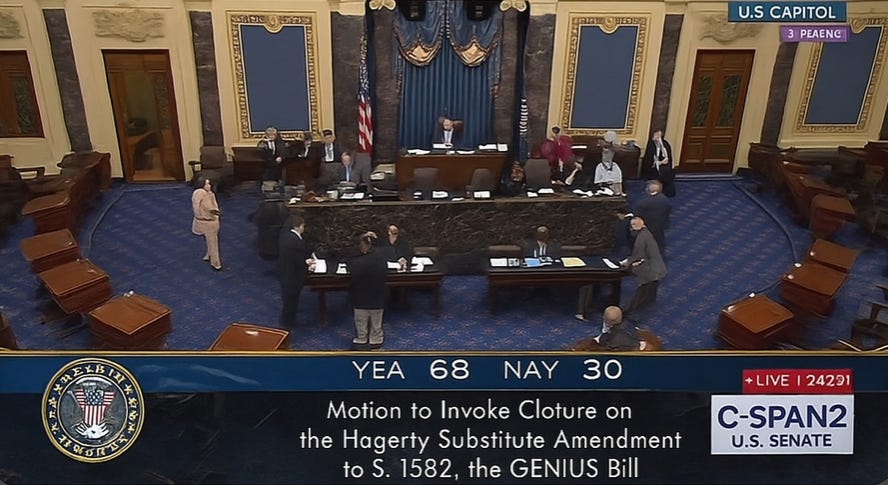
As of June 13, 2025, the "GENIUS Act" (Guiding and Establishing National Innovation for U.S. Stablecoins) was JUST passed through the Senate. The bill aims to regulate the $238 billion stablecoin market, setting clear rules for who can issue stablecoins and how they must be backed—typically 1:1 by cash or short-term Treasuries.
Key Provisions and Expected Impact
Regulatory Clarity for Stablecoins
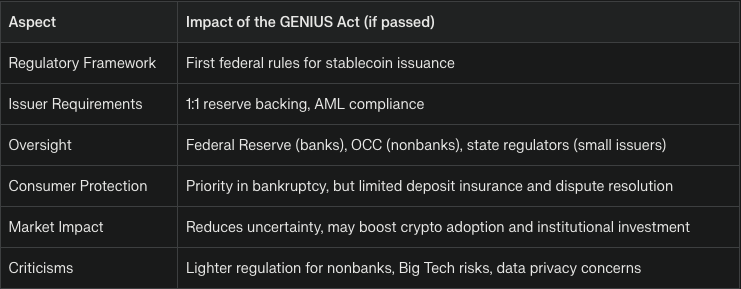
The GENIUS Act would establish the first federal framework for stablecoins in the U.S., mandating that issuers maintain full reserve backing and comply with anti-money laundering laws.
Both banks and non-bank entities could issue stablecoins if they register and meet regulatory criteria.
For issuers with over $10 billion in stablecoins, the Federal Reserve would oversee banks, and the OCC would oversee nonbank issuers.
State regulators would oversee smaller issuers (under $10 billion).
Consumer Protection and Financial Stability
The bill prioritizes stablecoin holders in the event of issuer bankruptcy, giving them priority over other creditors.
It bans misleading marketing, unauthorized yield products, and foreign issuers dodging U.S. oversight.
However, critics argue that the bill lacks robust consumer protections such as deposit insurance, clear dispute resolution, and liability limitations for unauthorized transactions.
Impact on the Crypto Market and Financial System
The legislation is expected to reduce regulatory uncertainty, which could accelerate crypto adoption and integration into mainstream financial markets.
Banks and financial institutions would be enabled to issue stablecoins, potentially unlocking new opportunities for innovation and payment systems.
Stablecoins are already central to crypto payments, trading, and decentralized finance (DeFi), and the bill could further cement their role.
The market may see increased institutional investment and broader use of stablecoins, which could drive demand for underlying blockchain tokens like Ether and Solana.
Criticisms and Concerns
Some lawmakers and consumer advocates worry about insufficient safeguards against corruption, regulatory arbitrage, and risks posed by Big Tech entering the banking space.
Concerns have also been raised about the concentration of regulatory power and potential data privacy issues.
Summary Table
Current Status
The GENIUS Act, just passed by the Senate, has cleared major procedural hurdles and enjoys bipartisan support, but it has not yet been passed by both chambers of Congress or signed into law. If enacted, enforcement would likely begin in Q3 2026. The bill represents a significant step toward legitimizing stablecoins and integrating them into the U.S. financial system, but its ultimate impact will depend on final amendments and implementation details.



By Douglas J. Boggs, founder of "Smoke and Mirrors…and the Art of Critical Thinking" and author of “Quantum of Justice - The Fraud of Foreclosure and the Illegal Securitization of Notes by Wall Street”. Douglas has two new books coming out in early 2025 to include: “The Psychology of Money” and “Mental Toughness for the Crypto Investor / Entrepreneur” to help guide readers through the investing world of crypto.


